ChargeZone's 1,000 New Sites Will Carry 480kW Chargers
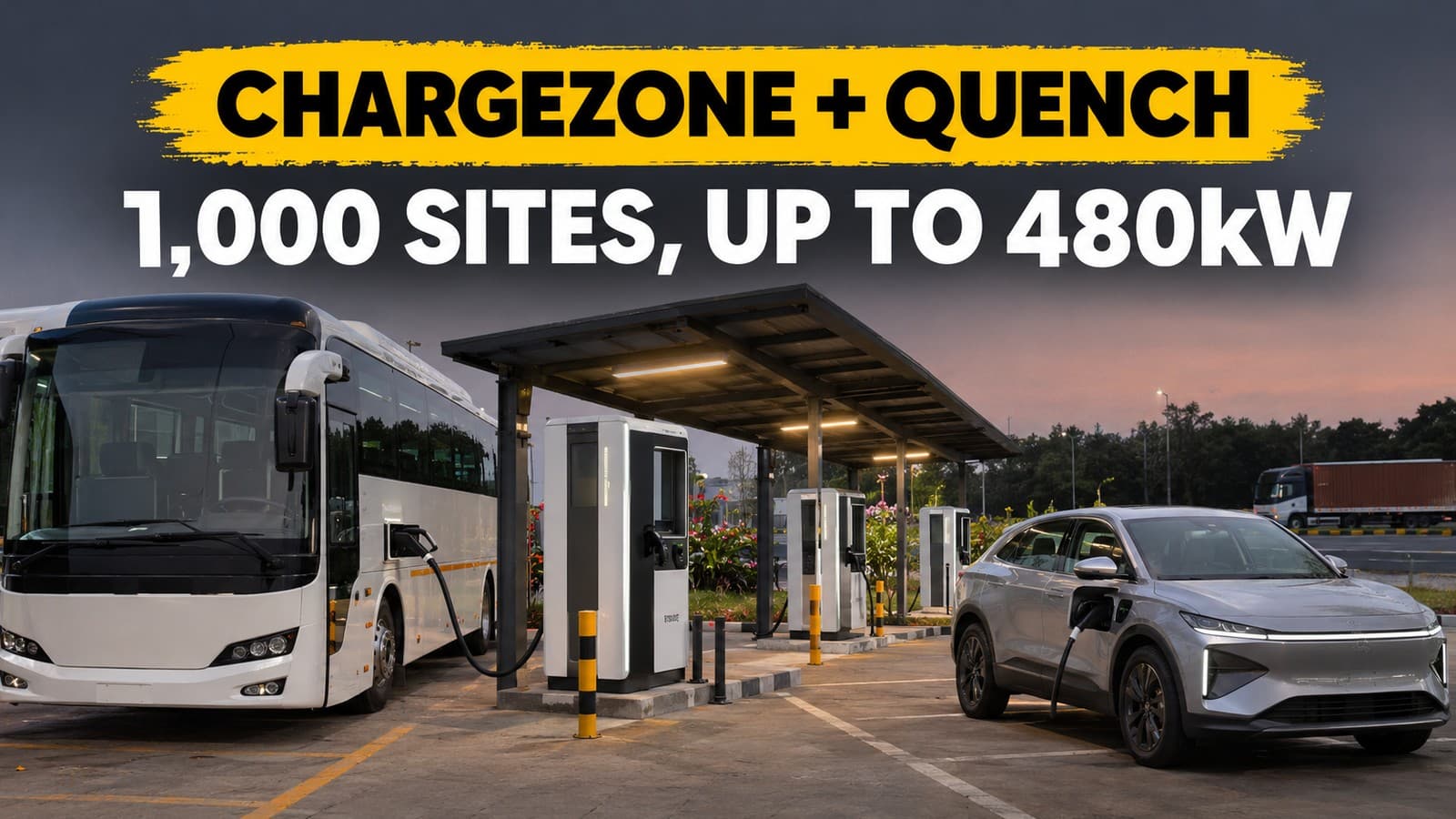
Representative image (AI-generated)
ChargeZone has settled who builds the hardware for its next 1,000 charging locations, and the top number on the spec sheet is 480kW.
The partner is Quench Chargers, a wholly owned arm of Ador Powertron that has already put more than 1,500 DC fast chargers on the ground in India. It is an expansion of an old relationship rather than a new one — ChargeZone was Quench's first fast-charger customer, according to Ador Powertron chairperson Ravin Mirchandani.
120kW for your car, 480kW for a bus
The two companies are splitting the 1,000 sites by what plugs in. Passenger EVs get 120kW units along highways and intercity routes. The 360kW and 480kW dispensers are aimed at the heavy stuff — buses, trucks and any fleet running to a fixed timetable that cannot afford to sit around waiting.
What makes one deal cover both is the way the hardware is built: 30kW AC-DC converter blocks that stack, so the same family of parts configures anywhere from 30kW up to 480kW. Manufacturing is local, down to the rectifier and controller boards inside each unit. The companies claim efficiency above 96%, forced-air cooling and front-access servicing, the dull things that decide whether a charger is actually working when you arrive.
Why megawatts beat charger counts
India's public charger totals are close to useless as a yardstick. Figures between 27,737 and 67,657 get quoted for the same period depending on who is counting. Installed capacity in megawatts is the harder number, and that is where this plan is easier to judge.
ChargeZone's network capacity sits at 120MW today. The 1,000 new sites add roughly 180MW, taking it to 300MW — a shade over 2.5 times what it runs now. At full deployment the company expects about 700 GWh a year and more than 15,000 charging sessions a day, with utilisation climbing from about 14% to about 30%.
The 1,000-station plan itself is not new. It was announced in September alongside long-term charging contracts worth more than $1 billion, about ₹10,500 crore, tied to fleet work: buses and trucks on intercity runs, plus commercial car fleets. This week's announcement fills in the hardware half of it.
What this means for you
For a car owner the 120kW units matter most, and they are going in the same places the heavy fleets will use. That is good news: fleet contracts are what keep a highway charger alive between your two visits a year. ChargeZone already runs over 15,000 charging points at 1,200-plus locations across India and the UAE, so this is a network getting denser, not a new one starting up. One gap worth flagging — neither company has given a deployment timeline, so treat it as capacity committed rather than capacity running. For what it does to your own running costs, our EV running-cost calculator does the maths, and Gadkari's ₹3-a-unit night charging proposal is the other half of that story.
Sources: Autocar Professional (primary, partnership, charger ratings, 300MW target), EVreporter (September contracts, 120MW to 300MW, GWh and utilisation), Motoroids (corroboration on contract value and capacity)
Thinking about installing a charger?
Run your own numbers on the EV Charger ROI Calculator — payback period, monthly profit and investment needed, in under a minute.
Calculate your charger ROI →On This Page
Trending
- Hero VIDA UBX 06 Pro Electric Bike Could Launch in India in 2027, Here's What We Know
- Hero VIDA VX2 Wireless Charging Revealed: Charge Without Plugging In
- Hero VIDA Project VXZ: New Electric Motorcycle Showcased at EICMA 2026
- Mahindra Electric SUV Output Jumps 50% to 12,000 a Month
- Tata iRA.ev App: 4 High-Severity Flaws, Already Patched
- Gadkari Proposes ₹3/Unit Night EV Charging for Maharashtra
- Cabinet Clears ₹14,500 Crore for 92 GWh of Battery Storage