
Ultraviolette X-47 Venom Review: It Took Us 18 Minutes to Overheat It
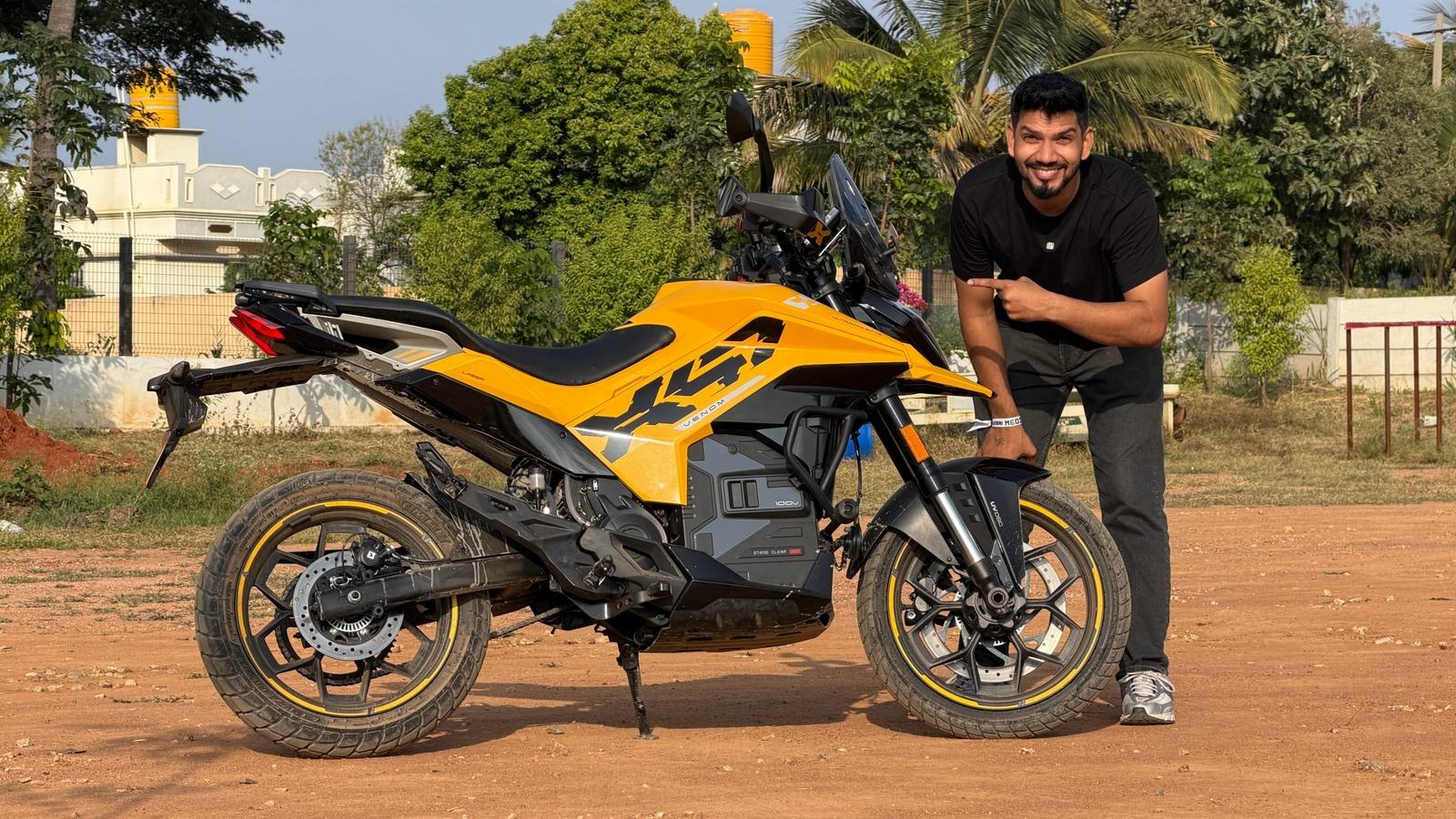
Photo: EVGyan
It took 18 minutes of riding at 110 to 140 km/h before the Ultraviolette X-47 Venom's motor got hot enough to cut power. Three to four minutes later, full performance was back.
That is the main finding from our Ultraviolette X-47 Venom review, published on the EVGyan channel on 21 November 2026. Tarun Pal did the riding, a year and a month after we tested the first X-47. The body is the same and almost everything under it is new, so we went straight to the torture tests.
Key Takeaways
- 155 km/h seen on the display, matching Ultraviolette's claimed top speed.
- About 2 seconds quicker to 100 km/h than the old X-47 in our side-by-side footage.
- At a sustained 110-140 km/h, the bike switched to Glide mode around the 18th minute. Full power returned in 3 to 4 minutes.
- 12 kW fast charging is untested. The charger we used was a 3 kW unit.
- Weak spots: Mappls navigation, a sharp front brake, no radar on the 7.5 kWh variants.
What is new on the X-47 Venom
The platform is new, and the bike is lighter because of it. The Venom uses Ultraviolette's VX-100 architecture, which runs at 100 volts where the old bike ran at about 50. The official spec sheet lists the same body at 2,060 mm long, 867 mm wide and 1,220 mm tall, with a 1,385 mm wheelbase and an 820 mm seat.
The 7.5 kWh variants now weigh 180 kg, 17 kg less than before. The 11 kWh Recon variants weigh 195 kg, down 13 kg. The Venom has also gone on sale in Europe.
Is it actually quicker?
Yes, and the gain comes after 60 km/h. We ran our footage of the old X-47 next to the Venom. Till 40 km/h there was almost nothing between them, and at 60 the gap was small. By 100 km/h the Venom was about 2 seconds ahead. Ultraviolette claims 0-100 km/h in 5.9 seconds.
The old motor used to fade after 60. This one keeps pulling to 155 km/h, and it does so on air cooling alone, which is why the next test mattered.
How long before the motor heats up?
About 18 minutes of sustained high-speed riding. In Ballistic mode on the highway, we held 110 to 140 km/h for 20 to 25 minutes, covering 35 to 40 km. Around the 18th minute the display showed "Switching to Glide Mode", and Combat and Ballistic were locked out.
The good part: Glide mode still took the bike to 100 km/h, and the motor cooled in 3 to 4 minutes, after which both faster modes came back.
Regen is the thing to watch. We had it off on the highway. Back in the city, at the highest level, the freshly cooled motor heated up again before recovering quickly. Journalists who ran maximum regen on the track saw the warning sooner than we did. If you are riding hard, turn regen down.
Want to see the warning come up, and our plastic-bottle test on the hot motor? Watch it here.
Does it slow down on low battery?
Not until the charge drops below 11%. Ballistic mode was still on offer at 13% and at 11%. Below that the bike drops to Glide mode. In the last 5% it enters Hover mode, where the screen goes almost blank and speed stays at 50 to 60 km/h.
Regen also starts earlier now. Ultraviolette told us it works from 99% charge, where the old bike waited till 90%, and at its highest level it slows the bike almost like the brakes do.
Ride and brakes
The lost weight shows up first in the city. Tight U-turns took less effort, and on a broken, flooded stretch we were less worried about the bike tipping over. The seat has extra padding, and more than 100 km in the saddle brought no real discomfort.
The softer front suspension has a cost. Use only the front brake and the fork dives fully, and the bike shakes a little. The front brake bites too sharply and the rear could be stronger. Used together, they are fine. A damping change should sort it.
12 kW charging: the maths works, the test is pending
We have not tested it. The DC charger we plugged into during the shoot was a 3 kW unit, and the 12 kW ones are yet to go live.
The idea is simple: power is voltage multiplied by current. The old platform took 120 amps at about 50 volts, which gives 6 kW. The same 120 amps at 100 volts is 12 kW, without the extra heat that more current would bring.
Here is our own sum for the 11 kWh pack. Going from 20% to 80% means adding 6.6 kWh, which is 60% of 11. At a steady 12 kW that takes 6.6 ÷ 12 = 0.55 hours, or 33 minutes. The spec sheet lists 2 hours 45 minutes for the same top-up on the 3 kW boost charger. We will test it once those chargers are live.
Screen and features
The new 7-inch touchscreen is a clear step up. It starts quickly, showed no lag and stayed readable in direct sunlight. The dashcam feed now shows on the same screen, and cruise control has finally arrived, engaging above 30 km/h.
Navigation let us down. The Mappls maps sent us the wrong way several times and lost network on the move.
What this means for you
The Venom is now a bike you can plan highway rides on, with two conditions: keep regen low when riding hard, and wait for owner reports on 12 kW charging. The top 11 kWh variant should give about 250 km in normal use and 150 to 180 km ridden like our test. Ultraviolette's own figures for that pack are 275 km in Glide mode and 193 km in Ballistic.
These are the prices on Ultraviolette's configurator, ex-showroom Bengaluru, as on 22 November 2026, after its Carbon Farewell Fund offer of up to ₹35,000.
- X-47 Venom (7.5 kWh): ₹2,65,000
- X-47 Venom + (7.5 kWh): ₹3,15,000
- X-47 Venom Recon (11 kWh): ₹3,75,000
- X-47 Venom Recon + (11 kWh): ₹3,99,900
Radar now needs the 11 kWh pack, so the Recon is the cheapest way to get it.
One check before you book: service. Ultraviolette logged 519 registrations in October 2026 against 91 a year earlier. Owners told us in the comments on our last X-47 video that service and spare parts are a problem. We put this to the company, which told us it is working on it. Until owners confirm the change, speak to a few in your city before you pay.
Not sure which EV is right for you?
Get the free EV Buying Decision Guide — real range vs claimed range, and a clear buy-or-wait answer based on your own situation.
Get the free buying guide →Sources
Get India's monthly EV sales data by email
Every month we pull the Vahan registration numbers apart — by segment, by state, by model — and send you what actually changed. No brand pressure, no hype.
One email a month. Unsubscribe anytime. See our privacy policy.
Read next
On This Page
Latest
- Ather Konarc S 125 Real Range: 92 km on a Single Charge
- Ather Konarc S 100 vs Bajaj Chetak C2501: Just ₹197 Apart
- VinFast VF5 Facelift Revealed With a 43kWh Battery, and It Is Already Patented in India
- Electric Defender Confirmed for 2027, Smaller Than the Defender 90
- Mahindra and Uber Are Going After 5,000 Electric Autos
- Mahindra M13Electro Brakes at 700 kW, Races at Just 450 kW
- Tata EV Supply Hits 16,000 a Month, Nearly 20,000 Is Next