
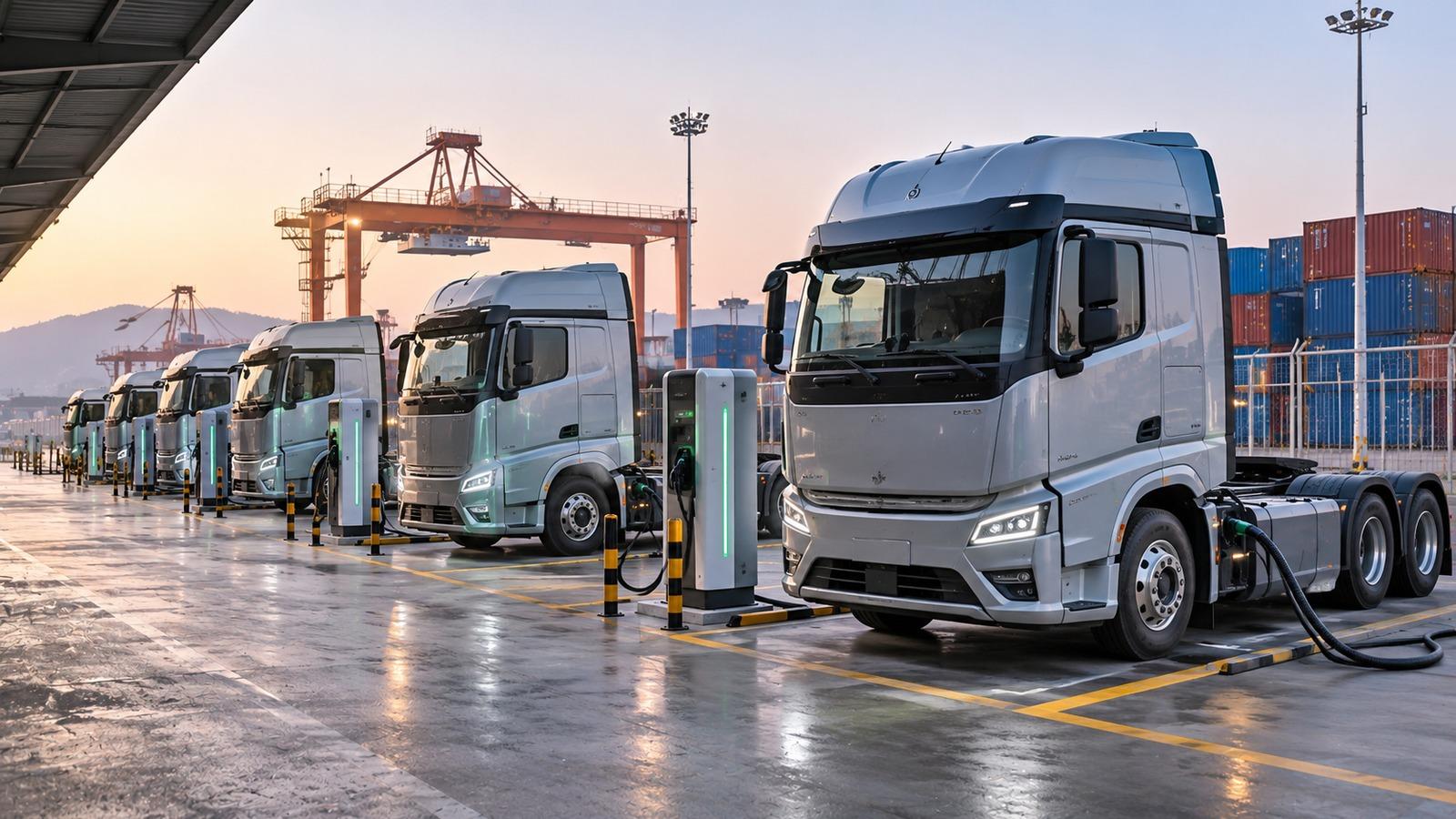
Representative image (AI-generated)
In September, 50.3% of the heavy trucks sold in China were electric. That is about 33,100 trucks in one month, up 37% on the same month last year, and it happened in a market where total heavy truck sales actually fell 21%. China electric truck sales are no longer a pilot project. They are the default choice for half the buyers.
The figures come via Electrek, reading Chinese sales data, and they line up with what the segment has been doing for two years.
How fast this moved
- 2024: electric was 13.6% of China's heavy truck sales
- 2025: 231,100 units sold, up 182%, a 28.9% share
- December 2025: 53.9% in a single month, as buyers rushed ahead of a subsidy deadline
- March 2026: back down to about 23% once the rush ended
- January to September 2026: 226,400 units, up 64%, a 38.1% share
- September 2026: 50.3%, and 64.5% for tractor units specifically
Read the March dip, because it matters. When the subsidy expired, the share more than halved. Six months later it was back above 50% without the subsidy. That is the moment a segment stops being policy-driven and starts being money-driven.
Beijing's own target was 40% of new-energy heavy truck sales by 2030. Monthly sales cleared it four years early. CATL, which makes the batteries, expects one in every two trucks China sells in a full year to be electric by 2028.
Diesel is the one paying for it
Kpler's estimates put Chinese diesel demand down roughly 420,000 barrels a day year-on-year in May, about 10%, and 460,000 barrels a day in June. For the full year it expects a drop of about 230,000 barrels a day, with a small 64,000 barrel rebound in 2027. Rhodium Group has China's diesel consumption falling from a peak of 4.7 million barrels a day in April 2023 to 4.0 million in April 2025.
Of the roughly 680,000 barrels a day displaced in 2026, Kpler attributes about 450,000 to LNG trucks and 230,000 to electric. Electric overtook LNG in July, taking 47% of heavy-duty registrations against LNG's 11%.
Where India actually stands
Here is the uncomfortable arithmetic, and it is worth doing honestly.
India registered 1,637 electric heavy goods carriers between January and August 2026, on Vahan-based analysis. That is up 618% year-on-year, which is a real number and a good one. It is also about one-twentieth of what China sold in September alone (33,100 divided by 1,637 is just over 20).
The lighter end is healthier. Electric light goods carriers took 17,292 registrations in the same eight months, up 202%, which is 73% of India's 23,540 electric commercial vehicle registrations. Tata Motors leads with 7,867 units and a 33.4% share, Euler Motors is second on 4,637.
And the heavy stuff is finally getting real orders rather than press releases. Amazon is putting 3,000 Tata electric trucks on Indian roads, starting with 20 Tata Ultra E.7s in Delhi: 7.5 tonne GVW, 96 kWh LFP pack, 240 kW motor, 3.1 tonne payload, up to 130 km of range. The next phase runs the Delhi-Chennai stretch of NH48, about 2,800 km. JSW Greentech has 100 AMPSTAR 55T electric tractor-trailers hauling for JSW Cement.
The EVGyan take
India is not behind the world on electric trucks. It is behind China. Europe registered 5,120 electric heavy trucks through September for a 2.5% share, and the United States is under 1%. Put differently, China is running at more than fifteen times the European rate.
What China got right is boring and copyable: the trucks run fixed routes, so you only need chargers at the depots and a handful of corridor stops, not a national network. CATL claims about 0.6 yuan per kilometre in savings. Work by the ICCT with CATARC puts a battery-electric truck at roughly 19% cheaper per tonne-kilometre than a diesel one, where conditions suit it. Once the cost per kilometre is lower, a fleet owner does the sum himself.
India already proved it can do this with buses. It registered 768 electric buses in October 2026, almost all of them on government contracts running fixed city routes from a depot that charges them overnight. A freight corridor is the same problem with a longer leg.
That is exactly the shape India's e-truck story is taking. Amazon's NH48 plan and JSW's cement runs are both closed loops with known distances and a depot at each end. Get the charging right on a few of those corridors and the 1,637 figure looks very different a year from now. The 618% growth rate already says somebody has run the numbers.
What would make it move faster is not a bigger subsidy. It is megawatt charging at freight depots and a financing product a single-truck owner can actually sign, because the $411,200-versus-$172,500 gap the ICCT measured between an electric and a diesel Class 8 tractor in the US is the same gap an Indian transporter is staring at.
Sources
Get India's monthly EV sales data by email
Every month we pull the Vahan registration numbers apart — by segment, by state, by model — and send you what actually changed. No brand pressure, no hype.
One email a month. Unsubscribe anytime. See our privacy policy.
Read next
On This Page
Latest
- VinFast VF5 Facelift Revealed With a 43kWh Battery, and It Is Already Patented in India
- Tesla Model Y RWD Gets 43 km More Range, Price Unchanged
- Electric Defender Confirmed for 2027, Smaller Than the Defender 90
- Mahindra and Uber Are Going After 5,000 Electric Autos
- Mahindra M13Electro Brakes at 700 kW, Races at Just 450 kW
- Audi A4 e-tron Pushed to 2029 Over a 48-Volt Rethink
- COMAC CE-25A: China's 19-Seat Electric Plane Flies With a Crew