Panchayats Can Now Earn ₹1 a Unit From EV Charging
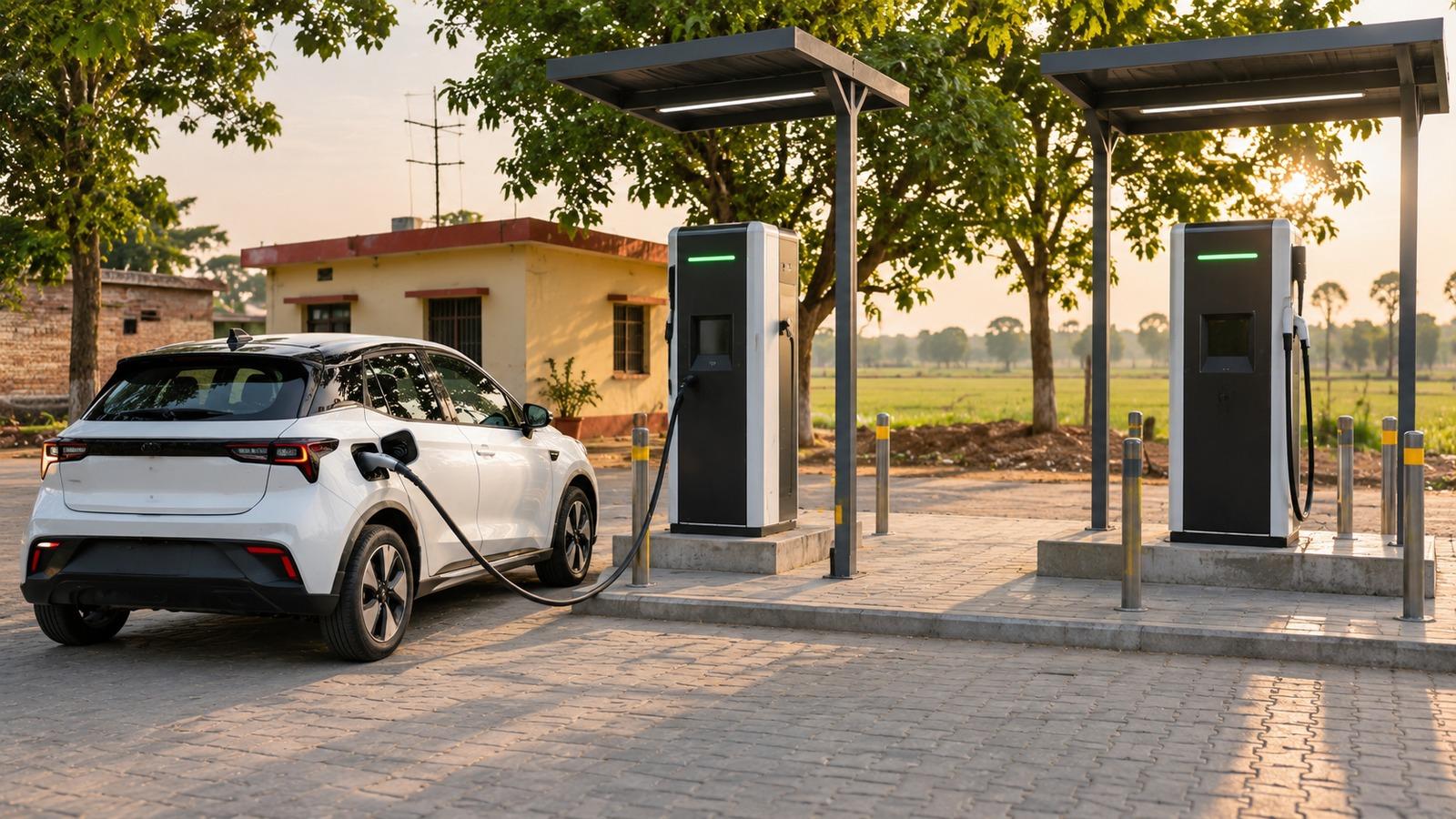
Set up an EV charger on panchayat land and the panchayat keeps ₹1 for every unit sold. That is the deal the Centre has signed, and it turns village land into a small energy business.
The Ministry of Panchayati Raj has signed an MoU with Convergence Energy Services Limited (CESL), a subsidiary of EESL under the power ministry, to build EV charging and battery-swapping stations on panchayat-owned land across the country. In Delhi, at the ministry's People's Plan Campaign workshop, joint secretary Mukta Shekhar and CESL chief executive Akhilesh Kumar Dixit put their names to it.
What a panchayat actually earns
On the figures reported so far, the money works out like this:
- Panchayat share: ₹1 out of every unit the station bills
- Small site, about 10 x 10 sq m: around ₹3,000 a month
- Large site, about 20 x 25 sq m: around ₹10,000 a month, or about ₹1.20 lakh a year
Those earnings numbers have come from a single source and have not been confirmed anywhere else, so treat them as indicative rather than final. ₹1.20 lakh a year will not build a road. It will keep streetlights on, and it lands as own-source revenue, the category panchayats are now being pushed to grow. Union minister Rajiv Ranjan Singh told the same workshop that gram panchayats need their own income to qualify for performance grants. A charger is one of the few ways a village body can earn without taxing anybody.
Who does what
The ministry works through state panchayati raj departments to pick the plots and keep an eye on them. CESL does everything after that: sizing up a location, working out how much demand it will see, buying and fitting the hardware, testing it, switching it on, then running and servicing it. Plots can sit next to a gram panchayat office or on panchayat land beside a state or national highway. The chargers are meant to take two- and three-wheelers, cars, and the heavier commercial stuff as well.
What this means for you
If you have been putting off an electric scooter because the road to your village has nothing to plug into, this is the right kind of news, with the usual caveat: an MoU is not a charger. There is no station target, no timeline and no investment figure in any of the announcements. What has changed is the land problem. Finding cheap, legally clean plots near a highway is the slowest part of building a charging network, and a panchayat that earns ₹1 a unit has a reason to say yes.
The EVGyan take
Almost every charger India has built so far sits in a city or at a toll plaza. The vehicles that most need rural charging are the ones nobody photographs: e-rickshaws, cargo three-wheelers, the scooter a milk route runs on. State-highway plots are also exactly where a three-wheeler driver runs out of range today. Giving the local body a cut is smart design: it makes the village a partner, not a landlord. Now someone has to dig.
Thinking about installing a charger?
Run your own numbers on the EV Charger ROI Calculator — payback period, monthly profit and investment needed, in under a minute.
Calculate your charger ROI →Sources
Get India's monthly EV sales data by email
Every month we pull the Vahan registration numbers apart — by segment, by state, by model — and send you what actually changed. No brand pressure, no hype.
One email a month. Unsubscribe anytime. See our privacy policy.
Read next
Latest
- VinFast VF5 Facelift Revealed With a 43kWh Battery, and It Is Already Patented in India
- Tesla Model Y RWD Gets 43 km More Range, Price Unchanged
- Electric Defender Confirmed for 2027, Smaller Than the Defender 90
- Mahindra and Uber Are Going After 5,000 Electric Autos
- Mahindra M13Electro Brakes at 700 kW, Races at Just 450 kW
- Audi A4 e-tron Pushed to 2029 Over a 48-Volt Rethink
- COMAC CE-25A: China's 19-Seat Electric Plane Flies With a Crew