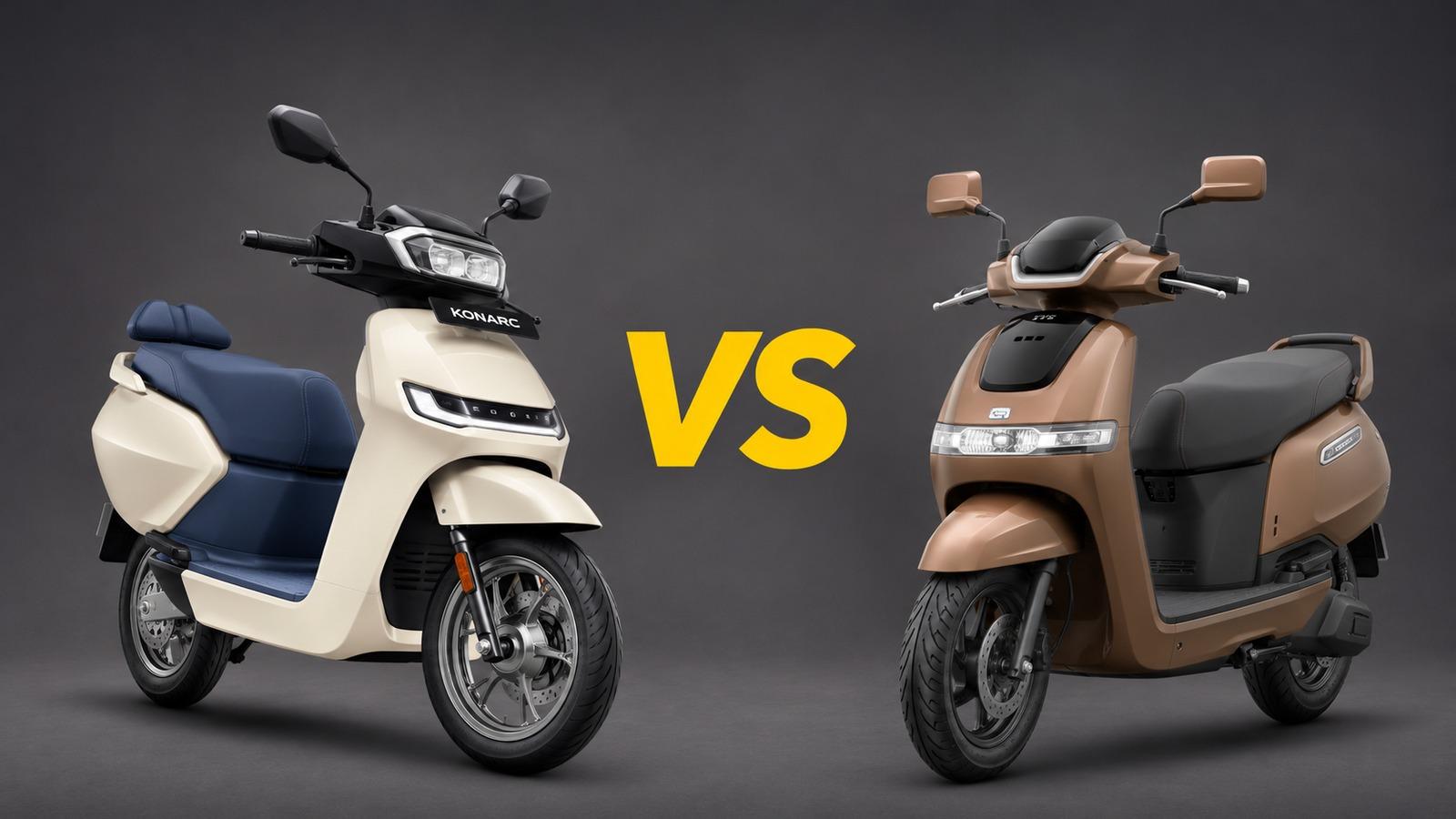
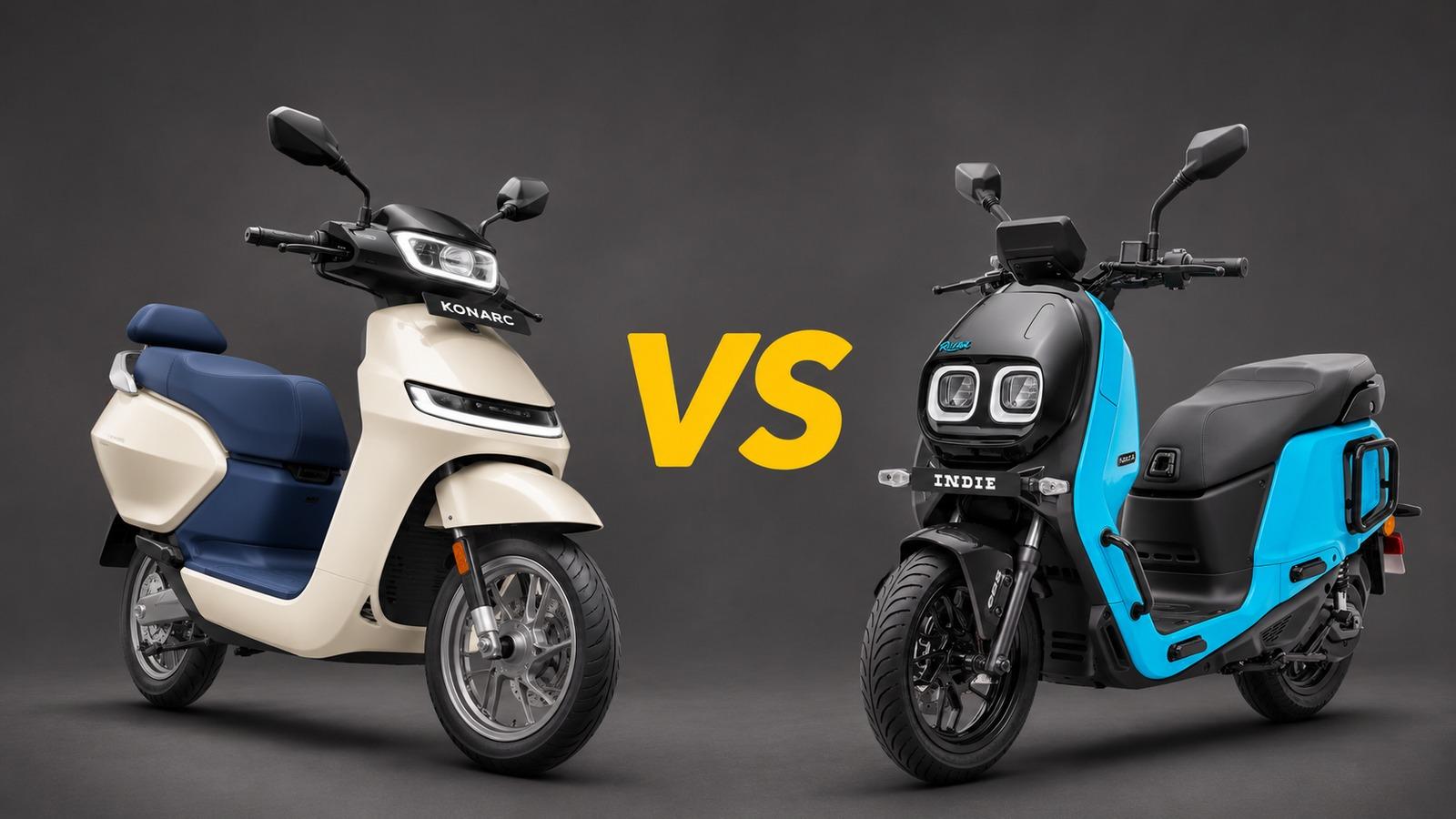
₹3,413 buys you 16 km. The Ather Konarc S 161 is ₹1,44,999 and claims 161 km; the TVS iQube 3.5 kWh is ₹1,41,586 and claims 145 km, both ex-showroom Bengaluru.
That is one of the tightest price gaps between two 3.5 kWh scooters on sale today, which makes the rest of the spec sheet unusually important.
Same battery, different priorities
| Ather Konarc S 161 | TVS iQube 3.5 kWh | |
|---|---|---|
| Price (ex-showroom, Bengaluru) | ₹1,44,999 | ₹1,41,586 |
| Battery | 3.5 kWh | 3.5 kWh |
| Claimed range | 161 km (IDC) | 145 km |
| Top speed | 70 km/h | 82 km/h |
| Motor | 4.7 kW, 16 Nm | 4.4 kW peak |
| Boot space | 31 litres | — |
Identical battery size, 16 km difference in claimed range. Ather has tuned the Konarc for efficiency; TVS has tuned the iQube for speed. The iQube's 82 km/h top speed is 12 km/h higher, and on a highway stretch or a long flyover, you will feel it.
Ather's TrueRange figure for the S 161 is 130 km, which is the number to plan around rather than the 161 km IDC claim.
Charging: the Konarc's cable trick
The Konarc S 161 comes with a 450W additional charger as standard, which works alongside the 450W charger already built into the scooter. Used together, that is 900W combined and a 0-80% time of about 3 hours 10 minutes. On the built-in charger alone it is 5 hours 40 minutes.
The practical win is that the built-in charger means you can carry a plain cable instead of a charging brick for everyday top-ups. Anyone who has hauled a charger up three floors will understand why that matters.
TVS supplies a portable charger with the iQube and quotes about 3 hours 45 minutes for 10-80% on the 3.5 kWh pack. That is broadly comparable.
DC fast charging decides this one
The Konarc can use Ather Grid, which crossed over 5,000 public fast chargers nationwide as of Ather's January 2026 network update, with Ather claiming up to 15 km of range from 10 minutes plugged in.
TVS does not offer DC fast charging on the iQube. Its charging story is a portable charger and a 15A socket.
If you only ever charge overnight at home, that difference costs you nothing. If you ride unpredictable distances, or you share a parking spot where you cannot always plug in, it is the single biggest reason to pick the Konarc.
TVS has the stronger position right now
It would be wrong to read the spec sheet and assume the iQube is the weaker product. TVS shipped 71,382 electric two-wheelers in October, up 120%, and is targeting capacity of 80,000 a month. That is scale the Konarc has to earn.
It also means iQube service and spares are easy to find almost anywhere, which is not yet true of Ather in smaller towns.
What this means for you
If range and charging flexibility matter most to you: take the Konarc S 161. 16 km more on paper, 31 litres of boot, a cable instead of a brick, and a public fast-charging network behind it. The ₹3,413 premium is small for what it buys.
If you ride fast or often hit the highway: the iQube's 82 km/h top speed is the real differentiator — 12 km/h the Konarc simply cannot match.
If you just want the cheaper scooter and your commute is short: the iQube is also ₹3,413 less upfront, and 145 km claimed range covers most daily commutes without ever needing a fast charger.
FAQ
Is the Ather Konarc S 161 more expensive than the TVS iQube 3.5 kWh? Yes, by ₹3,413 — ₹1,44,999 against ₹1,41,586, both ex-showroom Bengaluru.
Which has better range, the Konarc S 161 or the iQube 3.5? The Konarc S 161 claims 161 km IDC against 145 km for the iQube 3.5, a 16 km gap from the same 3.5 kWh battery size.
Does the TVS iQube support DC fast charging? No. The iQube charges only from its portable charger or a 15A socket. The Konarc can use Ather Grid's public fast-charging network.
Which scooter is faster, the Konarc or the iQube? The TVS iQube tops out at 82 km/h against the Konarc's 70 km/h — a 12 km/h advantage for the iQube.
Prices are ex-showroom Bengaluru and change often. Confirm at the dealership before you book.
Not sure which EV is right for you?
Get the free EV Buying Decision Guide — real range vs claimed range, and a clear buy-or-wait answer based on your own situation.
Get the free buying guide →Sources
Get India's monthly EV sales data by email
Every month we pull the Vahan registration numbers apart — by segment, by state, by model — and send you what actually changed. No brand pressure, no hype.
One email a month. Unsubscribe anytime. See our privacy policy.
Read next
On This Page
Latest
- Accelero's eBik Jumps From 3,000 to 12,000 Units a Year
- CATL Is at 2,520 Swap Stations and Wants 3,000 by December
- China Exported 582,000 EVs in October, 16x India's Market
- China Rare Earth Curbs Delayed to 10 January: India's EVs Get 60 Days
- Force Traveller EV Arrives Q1 2027, ₹3,000 Crore Behind It
- Honda Ohio Plant: $3 Billion for Hybrids, Not EVs
- HPCL EV Charging Network Now 5,981 Points, 176 for Swapping