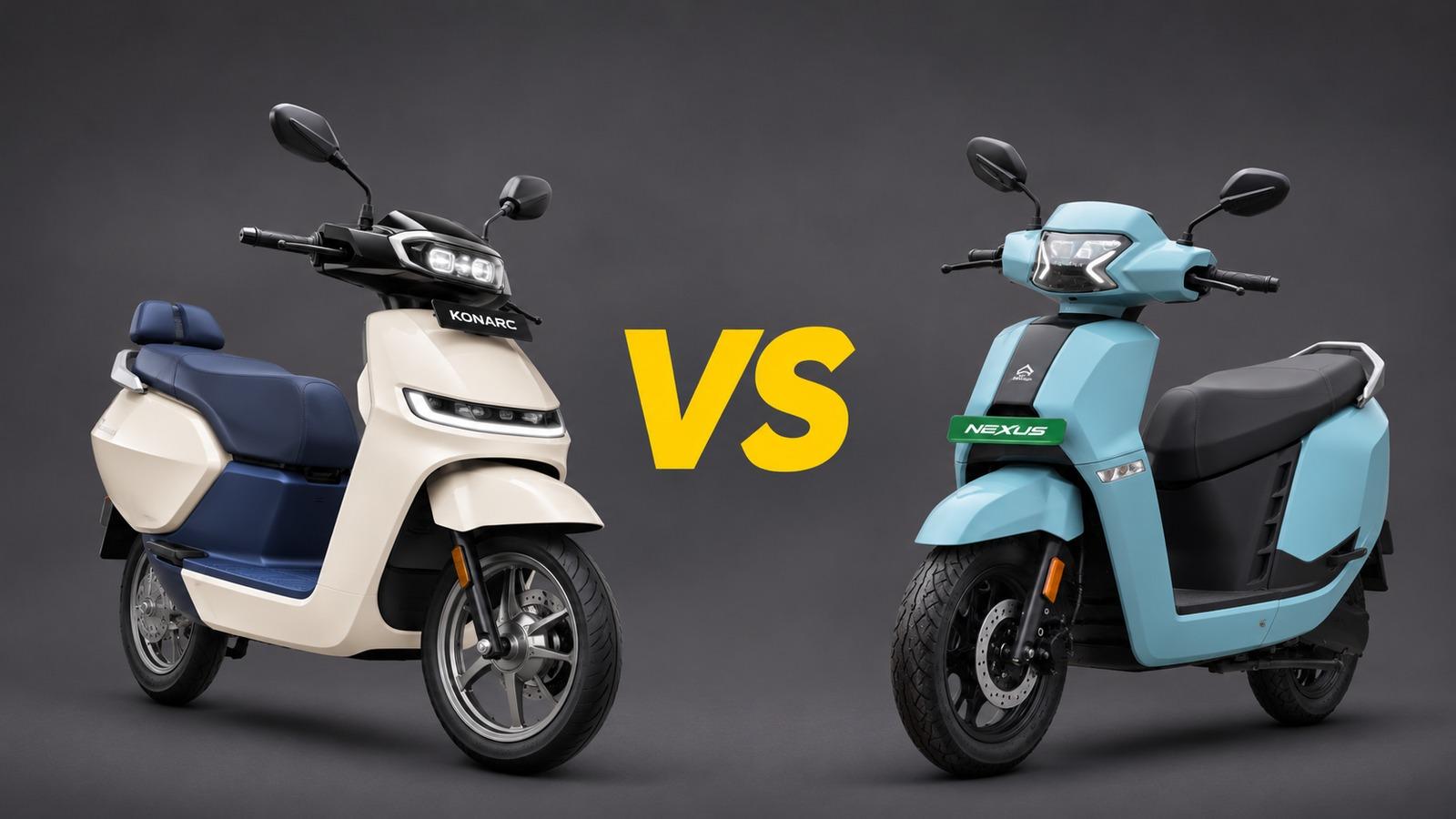
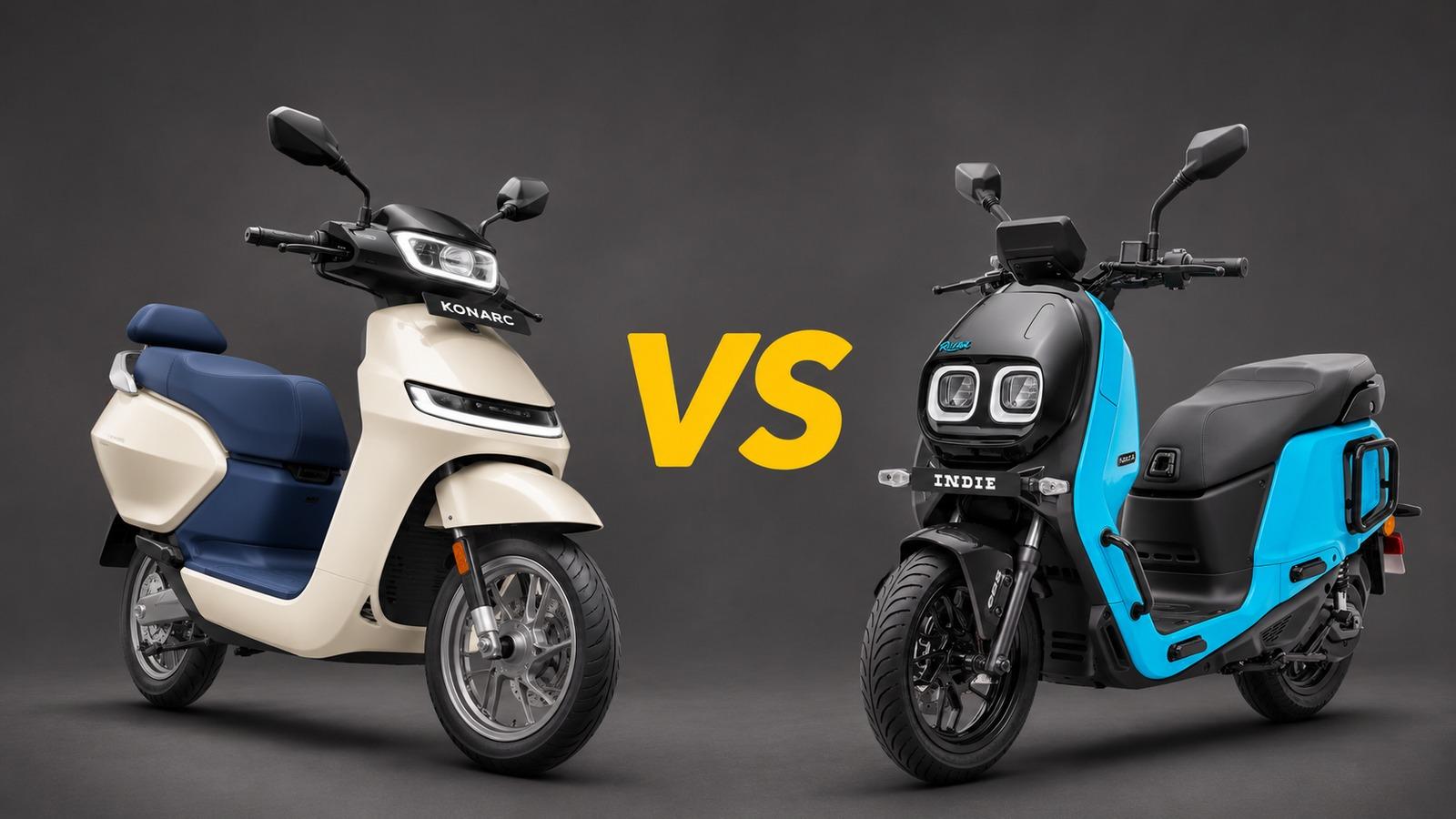
93 km/h against 70 km/h. That is the headline of this comparison, and it costs ₹8,000. The Ather Konarc S 125 is ₹1,21,999; the Ampere Nexus EX+ is ₹1,29,999, ex-showroom Bengaluru.
The Nexus also claims 11 km more range. So what is the Konarc doing here?
The Nexus wins the spec sheet
| Ather Konarc S 125 | Ampere Nexus EX+ | |
|---|---|---|
| Price (ex-showroom, Bengaluru) | ₹1,21,999 | ₹1,29,999 |
| Battery | 2.7 kWh | 3 kWh LFP |
| Claimed range | 125 km (IDC) | 136 km |
| Top speed | 70 km/h | 93 km/h |
| Motor | 4.7 kW, 16 Nm | 4 kW peak |
| Boot space | 31 litres | 22 litres |
The Nexus is the fastest scooter in any of our Konarc comparisons, and 93 km/h from a 3 kWh family scooter is genuinely impressive. Ampere also quotes a real-world figure of about 100 km, which is honest of them and matches Ather's TrueRange claim for the S 125 exactly.
So in the real world, both do roughly 100 km. One of them is ₹8,000 cheaper and has 9 litres more boot.
LFP is the Nexus's quiet advantage
The Nexus uses an LFP battery, which typically handles heat and charge cycles better than the NMC chemistry common in this segment. Ampere backs it with a 5-year/75,000 km battery warranty.
Ather counters with up to an 8-year battery warranty on the Konarc and a 10,000 km service interval. Both are strong ownership stories; read the fine print on what each warranty actually covers.
Charging and fast charging
Ampere ships a 15A charger with the Nexus and quotes about 3 hours 20 minutes. A faster 25A charger is sold as an accessory, so ask what it costs before you assume the quick time applies to you.
The Konarc has a 450W charger built in — cable, not brick — taking about 4 hours 30 minutes for 0-80% alone, or roughly 2 hours 25 minutes with a 450W additional charger working alongside it.
On public DC fast charging, the Konarc stands alone here. Ather Grid had crossed over 5,000 chargers nationwide as of Ather's January 2026 network update, with up to 15 km of range claimed per 10-minute stop. Ampere has no equivalent network.
What this means for you
If top speed is what you are shopping for: buy the Nexus EX+. 93 km/h is not a number anything else in this price band gets near, and the LFP pack is a sensible long-term choice.
If you want the better all-round deal: the Konarc S 125 is ₹8,000 less, matches the Nexus on real-world range, has 9 litres more boot, and plugs into a fast-charging network. The 70 km/h ceiling is the price you pay — and in city traffic, you will rarely touch it anyway.
If long-term battery chemistry matters to you: the Nexus's LFP pack is generally considered more heat-tolerant than NMC, which can matter over many Indian summers.
FAQ
Is the Ather Konarc S 125 cheaper than the Ampere Nexus EX+? Yes, by ₹8,000 — ₹1,21,999 against ₹1,29,999, both ex-showroom Bengaluru.
What top speed does the Ampere Nexus EX+ claim? 93 km/h, which is 23 km/h faster than the Konarc S 125's 70 km/h — the highest top speed in any Konarc comparison so far.
What battery chemistry does the Ampere Nexus use? LFP (lithium iron phosphate), which typically handles heat and repeated charge cycles better than the NMC chemistry common in this segment.
Does the Ampere Nexus support DC fast charging? No, the Nexus has no DC fast-charging network of its own, unlike the Konarc's access to Ather Grid.
Prices are ex-showroom Bengaluru and change often. Confirm at the dealership before you book.
Not sure which EV is right for you?
Get the free EV Buying Decision Guide — real range vs claimed range, and a clear buy-or-wait answer based on your own situation.
Get the free buying guide →Sources
Get India's monthly EV sales data by email
Every month we pull the Vahan registration numbers apart — by segment, by state, by model — and send you what actually changed. No brand pressure, no hype.
One email a month. Unsubscribe anytime. See our privacy policy.
Read next
On This Page
Latest
- Accelero's eBik Jumps From 3,000 to 12,000 Units a Year
- CATL Is at 2,520 Swap Stations and Wants 3,000 by December
- China Exported 582,000 EVs in October, 16x India's Market
- China Rare Earth Curbs Delayed to 10 January: India's EVs Get 60 Days
- Force Traveller EV Arrives Q1 2027, ₹3,000 Crore Behind It
- Honda Ohio Plant: $3 Billion for Hybrids, Not EVs
- HPCL EV Charging Network Now 5,981 Points, 176 for Swapping